
Beyond the David: the lesser-known gems of the Academy of Florence
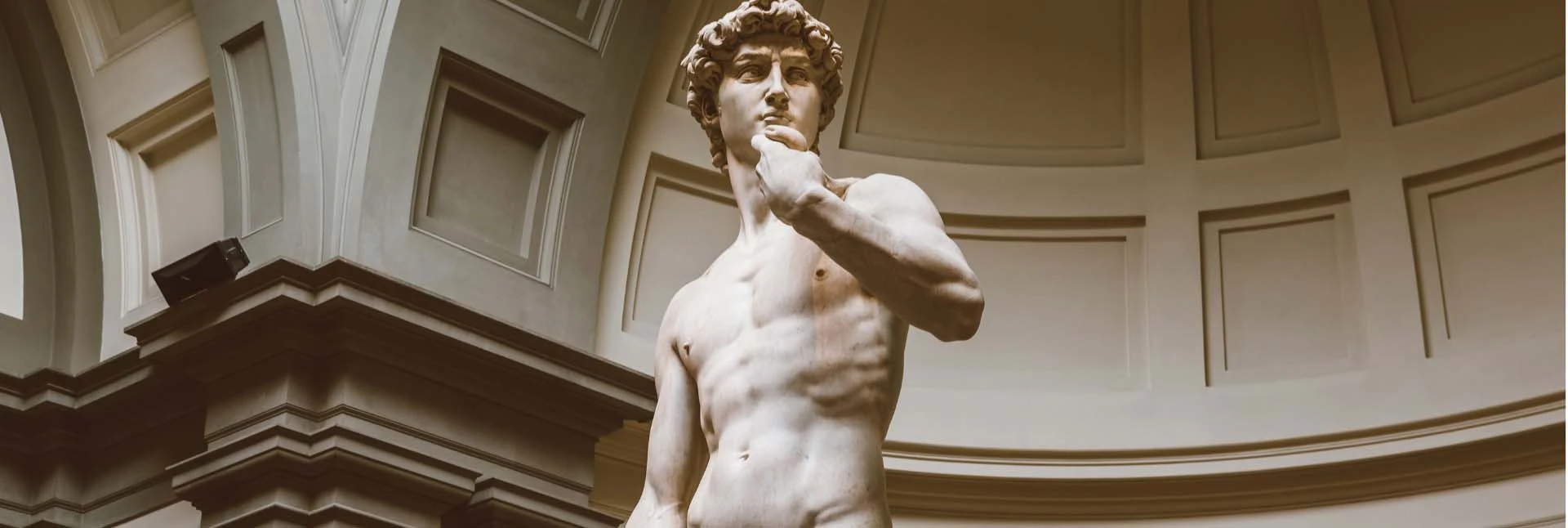
Normally, when we think of this museum, our mind goes directly to the imposing David by Michelangelo, one of the universal symbols of the Renaissance. However, as specialized guides, we love showing you the lesser-known aspects of the Academy of Florence, because it holds countless treasures that many visitors overlook. Would you like to discover them? We’re sure that afterwards you’ll want to visit them — and we’ll be delighted to accompany you!
The hidden universe behind the splendor of the David
Although the David draws all eyes to itself — and rightfully so — its presence should not overshadow the rest of the museum. The Academy is an essential space that gathers pieces from the Renaissance, Florentine musical tradition, and devotional art from the Trecento and Quattrocento. Even if you bought your tickets to see Michelangelo’s David, exploring the lesser-known aspects of the Academy of Florence is, in reality, discovering the museum’s true personality.
The Prigioni
The Prigioni, or Slaves, are perhaps one of the most revealing sculptural series of Michelangelo’s creative process. These figures are unfinished, so they seem to want to emerge from the stone, representing the artist’s “struggle” to liberate the form contained within the marble.
The sculptures were originally conceived for the tomb of Pope Julius II, but were never completed. For this reason, they convey an emotional intensity that often astonishes visitors. From our point of view, they are an essential stop on the tour because they show that the David did not come from nowhere — it is the result of an aesthetic search clearly visible in these earlier works.
San Matteo
Another gem by the artist is San Matteo. This piece, commissioned for the Cathedral of Florence, offers an intimate glimpse into Michelangelo’s restless spirit. The apostle seems to struggle to emerge from the block of marble, in a powerful and almost dramatic gesture. It is the perfect moment in our tours to explain the concept of non finito, an aesthetic principle that became inseparable from Michelangelo’s legacy.
The Pietà di Palestrina
Few works spark as much conversation among our travelers as the Pietà di Palestrina, whose authorship has been debated for decades. Traditionally attributed to Michelangelo, today it is suggested that it may have been completed — or even entirely created — by his disciples.
Its expressiveness is moving, the composition flows with contained tenderness, and the weight of Christ’s body seems to rest softly upon the figure of the Virgin.
The Cassone Adimari
This large painted panel, the Cassone Adimari, is one of the most charming works for those who want to glimpse life in fifteenth-century Florence. It is believed to depict the celebrations of a noble wedding, with its colorful streets, elegant dresses, and musical atmosphere.
The interest of this cassone lies not only in its beauty, but in its ability to transport us into a lively, everyday Florence, where the nobility displayed its power and the city became a ceremonial stage. It is one of those lesser-known aspects of the Academy of Florence that surprises visitors with its almost narrative character.
The musical instruments
In a less-visited room lies one of the most fascinating collections: the instruments of the Luigi Cherubini Conservatory. Here, unique pieces by Stradivari stand out, as well as creations by Bartolomeo Cristofori, the inventor of the piano.
This section is a paradise for music lovers, but also for curious-minded visitors, as it is a collection full of historical richness and intriguing details.
The Madonna del Mare
Among the most delicate paintings in the museum is the Madonna del Mare, an early work by Sandro Botticelli. Its soft palette, the treatment of the Virgin’s face, and the overall harmony of the composition reflect the artist’s sensitivity before his great masterpieces.
Many admirers of Botticelli are unaware that this piece is housed in the Academy. Taking a moment before it allows visitors to appreciate the Renaissance in its most intimate and contemplative form.
Ghirlandaio and everyday spirituality
Although less known to the general public than Botticelli or Michelangelo, the paintings of Domenico Ghirlandaio are extremely important, as this master of portraiture was practically the chronicler of everyday life in fifteenth-century Florence. His works stand out for their narrative clarity and their ability to integrate the sacred world with everyday settings.
Moreover, Ghirlandaio was the teacher of a young Michelangelo, and his style influenced the visual development of the Renaissance.
Historical spaces
Even less known is the presence of architectural and decorative elements from the old monastery that once occupied the building before it became a museum. The wooden choir and the ancient coffered ceilings offer a glimpse into the site’s religious past, creating a fascinating contrast with the Renaissance art now on display.
Don't hesitate to visit the Academy of Florence
It’s great to book your tickets to see Michelangelo’s David, but once inside the museum, the lesser-known aspects of the Academy of Florence will help you enjoy your experience even more — and we’re here to make that possible!