
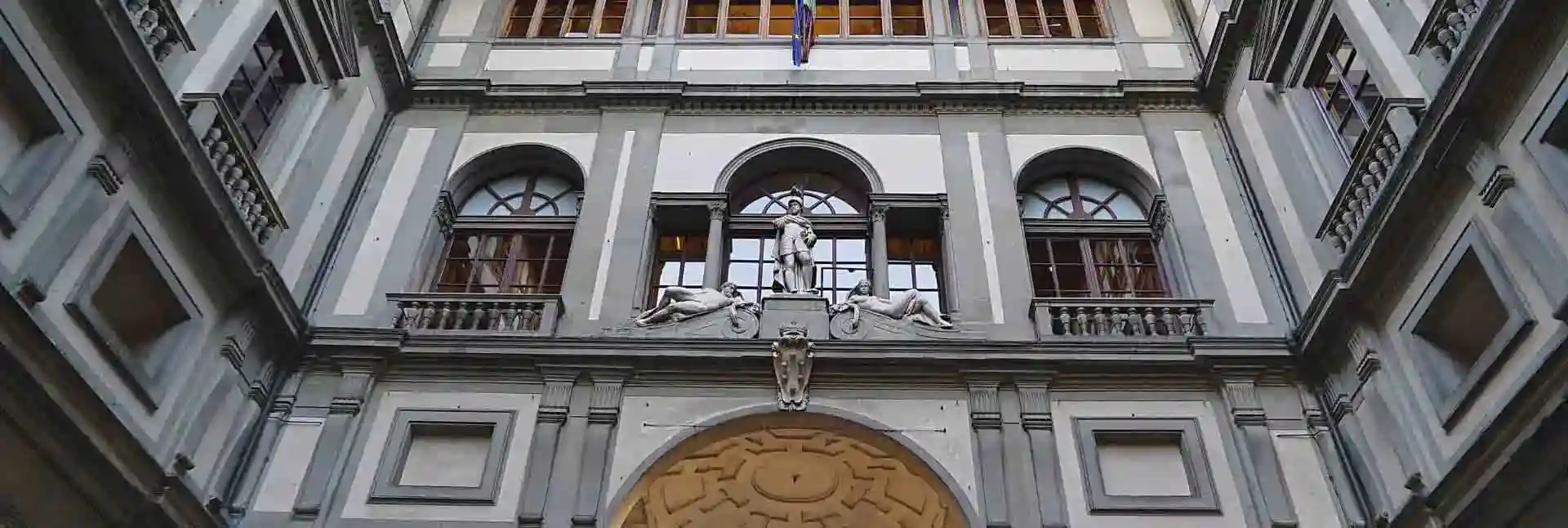
Discover the history of the building of the Academy of Florence
When we think of this building, we almost always picture Michelangelo’s David, standing before the public in its famous hall, right? But behind that iconic image lies the history of the Academy of Florence, with centuries of transformations, political decisions, urban reforms, and artistic aspirations. To understand its importance, there’s nothing better than discovering its origins — shall we begin?
Origins of the Academy: its historical context
First, we need to situate ourselves in the history of Florence’s artistic institutions. In the 16th century, the Grand Duke Cosimo I de’ Medici founded the Accademia delle Arti del Disegno in 1563, one of the first art academies in Europe, created to regulate and dignify the work of artists.
However, the building we visit today as the “Academy of Florence” was born in 1784, when Grand Duke Leopold of Habsburg-Lorraine undertook a deep reform of higher education in Tuscany. In this context, he reorganised the old Accademia delle Arti del Disegno and created the modern Academy of Fine Arts of Florence.
Leopold of Habsburg-Lorraine not only focused on the curriculum but also promoted the creation of an art gallery directly linked to the Academy, a space where students could study. This is how the Galleria dell’Accademia was born — a place where students could copy and directly analyse the great works of the past.
The first halls were filled with paintings and sculptures selected to teach students proportion, anatomy, composition and perspective.
The history of the Academy of Florence begins in 1784
The Academy was not built from scratch; instead, it incorporated two pre-existing medieval and Renaissance buildings. On one side stood the Hospital of San Matteo, founded in the 14th century, and on the other, the Convent of San Niccolò di Cafaggio, a religious complex in the same area.
Both buildings, already no longer in use, were integrated and fully remodelled to house the Academy and its new gallery. Its main purpose was twofold: first, to create a modern art school with classrooms and workspaces; and second, to establish a reference gallery where students could study original works and copies of the great masters.
The great turning point of the 19th century: the David and De Fabris’ tribune
The arrival of Michelangelo’s David inside the building marked a turning point in the history of the Academy of Florence, forever transforming the gallery’s identity and importance.
From the open air of Piazza della Signoria to the shelter of the Academy
Since 1504, the David had stood outdoors in front of the Palazzo Vecchio, in Piazza della Signoria. For centuries it was a symbol of the city and its liberty, but it was also exposed to rain, wind, and damage that slowly affected the marble.
By the mid-19th century, a heated debate arose in Florence: should the sculpture remain outdoors as a civic emblem, or should it be protected indoors? The conservationist position prevailed, and it was decided to move the David to an enclosed, safer environment. The Galleria dell’Accademia, already functioning as a gallery linked to the Academy of Fine Arts, was chosen as the new home.
The transfer took place in 1873. To move a marble statue weighing more than 5.5 tonnes, a wooden structure and rail system had to be built, allowing the sculpture to slowly advance from Piazza della Signoria to the Academy. If this would be complex today — imagine how it was then!
Emilio De Fabris and the creation of a “made-to-measure” space
Once it was decided that the David would enter the Academy, the big question emerged: where and how should it be placed inside the building? It wasn’t enough to find a large room; the city wanted a space truly worthy of its most famous sculpture.
Thus, a specific project was commissioned to architect Emilio De Fabris, professor at the Academy and known for his work on the façade of Santa Maria del Fiore. His mission was clear: design a tribune inside the gallery that would ensure good visibility and optimal conservation.
De Fabris created an apse-like space at the end of a nave, crowned by a dome with a skylight. The idea was for light to fall from above, highlighting the sculpture’s volume and emphasising its silhouette against the curved wall. Today, that natural light is carefully controlled and complemented by artificial lighting, but the original concept remains.
A David “kept away” for years
There’s a surprising detail in the story of the Academy of Florence: the David arrived at the gallery before its hall was ready.
In 1873, the sculpture was removed from Piazza della Signoria, but De Fabris’ tribune was not yet complete. What happened to the David then? While construction finished, the sculpture remained stored in a large wooden crate, a protective structure in which it waited for nearly nine years until its new home was ready.
In 1882, with the tribune completed, the David was placed at the centre of the apse, and since then, that room has become one of the most recognisable museum spaces in the world.
A building that encapsulates centuries of Florentine art
The history of the Academy of Florence is also the story of a city that has transformed, protected, and celebrated its buildings and masterpieces. As we walk through the gallery, we traverse corridors that were once hospital rooms, pass walls that belonged to monks, and enter a tribune conceived as a true sanctuary.
Do you want to experience this in person and observe unique details? Choose your tickets for the Academy of Florence, plan a tailored guided tour, or explore the artworks at your own pace with an engaging audio guide.